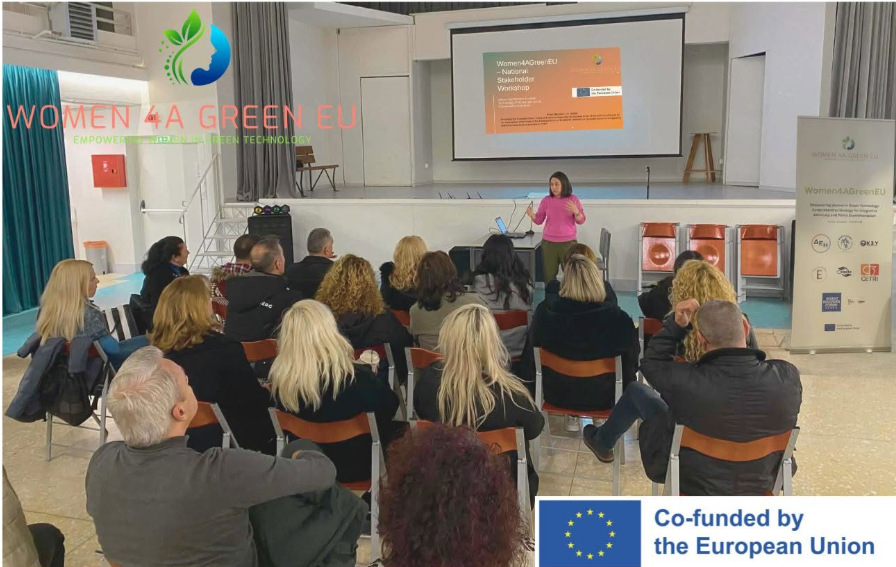


On 27 February 2026, the Women4AGreenEU project held its Greek National Stakeholder Workshop in Piraeus, organised jointly by CRADLE and PPC. The event brought together 44 participants representing higher education institutions, private companies, SMEs, VET providers, trainers, consultants, policy experts, entrepreneurs and business owners.
The workshop aimed to identify the main barriers and opportunities affecting women’s participation in green technology sectors in Greece. Participants were introduced to the objectives of Women4AGreenEU and the wider European policy context, including the European Green Deal and the European Skills Agenda. They then took part in structured breakout sessions focusing on barriers, good practices and the co-creation of policy solutions.
Discussions highlighted several persistent challenges, including limited awareness of green career pathways, gender stereotypes in STEM and technical education, weak alignment between education and labour market needs, and insufficient integration of gender equality into green transition policies. Participants also pointed to the lack of practical training opportunities, limited industry exposure and work-life balance challenges for women in technical and entrepreneurial roles.
Stakeholders proposed practical measures such as targeted VET and reskilling programmes for women, stronger partnerships between education providers and industry, mentoring and role-model initiatives, awareness campaigns, and incentives for employers supporting women in green jobs. Particular emphasis was placed on the need for regional and locally adapted approaches across Greece.
The workshop also generated important input for the Women4AGreenEU EU Policy Blueprint. Recommendations included integrating gender equality into national green transition policies, improving data collection, strengthening lifelong learning opportunities, supporting women’s entrepreneurship, and introducing common European indicators for women’s participation in green sectors.
Participants responded positively to the interactive format and expressed strong interest in remaining involved in the project. The workshop created a valuable platform for connecting actors from across the Greek ecosystem and demonstrated a clear readiness to support more coordinated, inclusive and gender-responsive green transition policies.